Problem
Monty Hall was a Canadian television host of the quiz programme “Let’s Make A Deal”. One one particular evening, he asked the contestant to pick out a door from a set of three doors in front of them, with the understanding that a car was behind one of them and a goat behind each of the other two doors. Simple enough. The twist comes into to play that, after having chosen the door (without having opened it), the contestant’s choice was kept in stasis by not opening the chosen door yet, until the host revealed what was behind a different door, apart from what the contestant had chosen, which was shown to have a goat behind it. Here is the depiction of the scenario. In this example, the contestant chose door number one (say), and the host then opened door number three (say).
The contestant is then given a choice of whether to make a with to door number two. Should he take the gamble or stick with the original door ? Does it matter ?

The problem is as much a philosophical problem as much as a mathematical one.
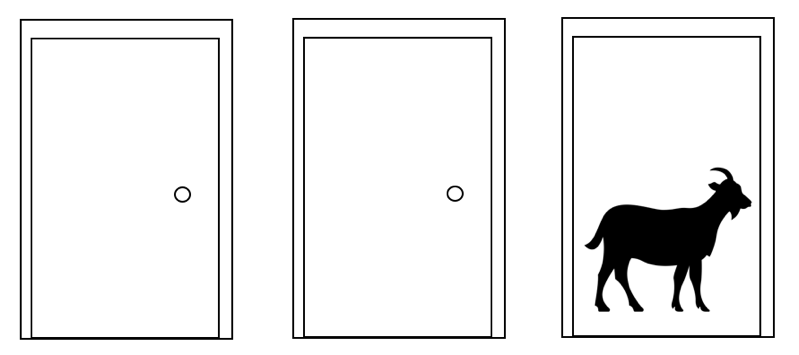
The first thing to establish is the probability of getting a car on the first of the contestant’s choosing. This is 1/3. There is only one car and two goats over the three doors. That’s the ‘game’ – 3 doors – 1 car. The next thing is to realise is that when the host asks you whether you want to switch doors, it is an invitation to play a different, new game. In this game, there are two doors – the one you chose and the one the host has left unopened and the one the host has opened. To switch means to reveal one fo these possible scenarios :
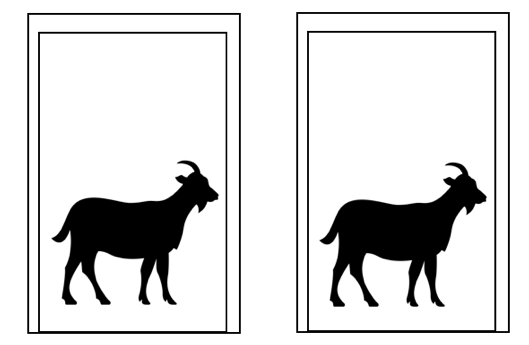

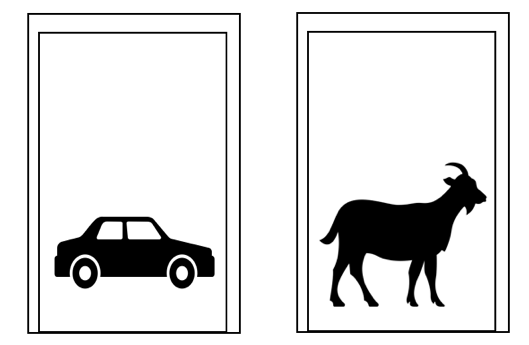
Now, in this game, there are three possible outcomes, two of them have a car in them (see above) one time the car to the left of the goat that was revealed and the other to the right. The probability calculus is independent of whether the host opened the second door or the third door. What matters is that it is not the door chosen by the contestant. There are three distinct outcomes for these two doors. Choosing to switch entails making actual one of the three outcomes, in which the car appears twice. Therefore, the probably of getting the car increases from 1/3 to 2/3 upon switching.
Contact
 Phyos
Phyos 