Contrary impressions on John Kerry’s Fulbright Distinguished Lecture, 9th of December 2022
Just before last Christmas, the Distinguished Fulbright Lecture was given by John Kerry, the United Nations Envoy on Climate. The lecture was entitled “The Urgency of the Climate Crisis”. Reading that title, I started to think there are only so many ways of raising the alert before a law of diminishing returns applies. I was reminded of those emails one gets with a red flag indicating ‘high priority’, replete with an exclamation point, or with ‘important’ emblazoned across the subject line. Once, I got an email that said, in its subject line, in bold capitals : “READ THIS NOW”. The presumption of the title indicated that those in attendance would be already convinced that there is 1) a climate crisis and that 2) that something would have to be done about it, and presumably soon.
It was with some hope for encountering or stimulating a more balanced, perhaps contrarian view that I went along. Perhaps I would find reason to see my contrarian scepticism challenged and refuted. Maybe I am wrong about man-made or anthropogenically-driven climate change ( what used to be called Global Warming). I went in through the Romanesque pillars of Bush House where the name of the place is etched in sandstone and in which the ‘U’ looks reassuringly like a ‘V’ as is usual in buildings of Roman antiquity. It was in Aldwych, in Central London, and it was hosted by the Policy Institute at Kings College London.
There were some security-related delays in getting to our seats, and as the crowd shuffled in, the rows were filled from the middle with alarming speed and I was left to muddle along to the front to get a seat typically left vacant by those in the crowd who don’t want to be seen. You certainly see this type of thing in religious services. However, when I got to the front, almost every seat was draped over with a large piece of paper indicating the name of some worthy, except for one seat at the edge. I thought to myself that I might take that, only to realise that it was next to the Principal of Kings’s College and only two seats away from John Kerry himself ! I thought of the line from the Gospel “he who exalts himself will be humbled” and thought better of taking that seat of privilege.
So it was the balcony for me or ‘up in the gods’ as some call it. Godly by height perhaps, but not by obstructed and abstracted view. As is usual these days with public lectures of this kind, the speaker had to be introduced by someone who themselves has to be introduced. In this case, the duty fell to my would-be fellow seating companion, Prof. Shitij Kapoor, of King’s College London. He trotted out various CO2-oblitertating initiatives and programmes being handled by the college, much to the applause of those gathered. There was ubiquitous mention of ‘Sharm El-Sheikh’, which was subsequently abbreviated to ‘Sharmel’ and, by the time we got to hear Mr. Kerry’s address, he was simply calling it ‘Sharm’. It was charming. The way they were saying it reminded me of Mount Carmel of Israel and that was fitting since they were talking about the location of the recent COP27 climate conference in Egypt, of which a sizeable contingent of the crowd were in attendance, as if they had come back from a holy gathering of brethren, as if it were some kind of haj or pilgrimage, but with 4-star+ hotels and first class flights.
Mr. Kerry took to the podium with great applause, after the Fulbright Programme coordinator introduced him, having made mention of the his public service record in the U.S. Navy during Vietnam, including two purple hearts, in his role Secretary of State, in his run for president. Mr. Kerry elaborated on his Vietnam days with a story about his return from Vietnam as a young veteran campaigning for the end of what he saw was a losing war, at the steps of the Washington Monument, and being given, to his surprise, a platform by none other than Senator William Fulbright himself, so that he could address the troops on this impassioned issue at the time. Then he told some rather amusing ice-breaker anecdotes, one involving an introduction by Clarence Pugh of U.S. President William Howard Taft. John Kerry mentioned the size or ‘girth’ of Mr. Taft at that stage in his life. He would have had to have stood back from the podium about a half a metre more than the lean-as-greyhound Mr. Kerry, as was demonstrated by the speaker. It didn’t seem to go over well with the Millenials in the auditorium, “was he fat-shaming ?” half of them were probably thinking ? Mr. Pugh was reported to have said “We await here a man – pregnant, pregnant with hope, pregnant with courage”. When Mr. Taft took to the speaking stage, he said “Well, if the baby turns out to be a boy, I’ll call him courage, if it’s a girl, I called her Hope, but if, as I suspect, it’s just gas, I shall call it Mr. Clarence Pugh !”. Thus concluded the opening remarks regarding the dangers of over-doing introductions. I was thinking of how difficult it is to make jokes in public in front of these new Fulbrighters. Jokes are not so welcome, because jokes might be found offensive. You can’t laugh either, because laughing presumes you are laughing at someone or something someone holds dear.
There seemed to have been one central statement of the damage wrought by climate change in Mr. Kerry’s address. This was the contention that 10 million people are now dying annually from ten heat. I immediately thought that surely it is the cold that kills more people, because of Jack Frost’s particular preference for lowering the body temperatures of elderly people such that they get the cold or ‘flu’ or whatever else that will kill them. Sure enough, as Ross Clark pointed out in the Spectator article, Mr. Kerry was referring to an article in the Lancet, written by an Australian research team which reported 5 million deaths due to weather extremes generally, not just heat, but also cold. In African countries, the number of cold deaths outnumber those due to extreme heat by a factor of 40. No wonder political pundits have swapped the term global warming for climate change. I suppose we’re expected to believe that CO2 cools the planet as well for political purposes ? We were told that rivers in France were running dry this years in places, too dry to cool the nuclear reactors. Does this happen every year ? Has it happened in the past. What is the quantitive baseline so that these claims can be evaluated ? Even if an event like this was due to atmospheric warming, we are still a long way from proving that it is CO2/greenhouse gas-driven. What is Mr. Kerry role in all of this ? As the evening wore one, I found the answer. He is an evangelist for the gospel of bad news that a tiny fraction that is our industrial CO2 of the 0.03 % of the CO2 in the atmosphere is going to regulate global temperature for many years to come.
He kept on saying that, at bottom, his stance was not coming from anywhere political, but was ultimately coming from Math and Physics. I couldn’t agree more. Which is why I found myself wondering at another statement he made – that half of the global warming that is happening (assuming it is happening) is due to methane. But Methane occurs in even more minute trace amounts that CO2. Its heat capacity (35 J per mole per Kelvin) is similar to water vapour(33.5) , and slightly less than CO2 (37) which is orders of magnitude more abundant. Perhaps, if you could tax clouds, that would have been included as a greenhouse gas. An audience member and chemist with whom I was chatting afterwards said that these rogue climate change agents have special rotational or vibrational states in them that allow for more efficient infra-read absorption. No they don’t. Not any more than humble old water vapour, whose heat you’ll feel on a warm day in Florida and in any greenhouse. Water absorbs right across the infrared with absorption coefficient of nearly 1. There’s only so much infrared energy a molecule can store. And methane is no different. So cows should be allowed flatulate in peace. And cow farmers of developing countries (and New Zealand and Ireland) should be allowed to let them and earn a living. In the middle of all of this apocalyptic prophesying, Mr. Kerry dropped in a Biblical quotation “The truth will set you free”. Yes, but for this “truth”, I would have some questions.
After the lecture was over, there followed immediately afterwards “a conversation” which often takes place nowadays instead of a robust and challenging Q & A segment. This conversation usually involves the host sitting down in a comfy chair only to lob even more soft and cushy questions at the speaker. During the conversation afterwards, Mr. Kerry re-affirmed his pseudo-evangelical mission “I need to proselytise you …with the truth I have spoken”. At that point, I felt a weakness and a cloying manner in his rhetorical demeanour. When the host finally turned things to the audience, we were told that, owing to the constraints of time (Mr. Kerry in fairness lamented this with the phrase – “you are such hard-arses for time !”), there was only going to be two questions. One allowed from the young and fresh cadre of eager Fulbrighters and the other picked out at random from a the back row.
As the crowd broker up afterwards, I was thinking about another statement from the talk, namely that the IPCC have been making accurate climate predictions going back as far as the Rio Summit in 1992, an event which made it’s way into the narrow confines of my teenage heavy metal interest in the opening lyric (if you could call it that) of Sepultura’s very popular and very well-known ditty by the name of “Biotech is Godzilla” from their album Chaos A.D. Accurate predictions ? I turned to the audience member who was shuffling out of the row beside me, a studious and conscientious looking fellow, to whom I said : “You can’t predict the weather next week with any accuracy, how can they say that they can predict it in the next ten years to the nearest half a degree ?” He retorted that I was confounding weather and climate. He elaborated that, while we might not be able to predict the weather with any accuracy after 7 days, since climate represents aggregations of weather patterns, averaged over time, we could still get the trend right overall. He made the analogy of predicting loaded dice falls in a casino. Which we would not be able to get every dice fall right, we would nevertheless, because of the loading, be able to predict the general trend. I wondered about this. Let’s say, for argument sake, that the weather is like a casino, and our models know how the dice are loaded to bias a warming trend, we’d still on average be able to predict the weather from next week. Not everyday would be right, of course, because of the inherent randomness, but because of the loading, the predictions would be more often right, or close to being right, than not. On average then, the forecasts would tend to the measured temperature. But this doesn’t happen, weather predictions (and hence the aggregated trends we call climate) are so unreliable and far from the measured reality, that meteorological services don’t even publish them. How can we be expected then, to believe that we can predict, never mind attribute warming to the nearest half a degree in 10 years’ time. Models don’t suddenly become accurate when you dispense with the advantage of trying to predict only a few days out, quite the opposite in fact.The weather system of the Earth’s atmosphere is not like a casino. In mathematical language, it is not stochastic, it is deterministic. It is governed by as-yet-analytically-unsolved (The Millennium prize in mathematics is going a-begging for a correct solution) Navier-Stokes, named partially after Gabriel Stokes from Co. Sligo in Ireland. The trajectory of weather and hence of climate, is a strongly non-linear system – a chaotic system. We are living in Chaos A.D. after all. One of the key features of such a system is an exponential dependence on initial conditions. Once a tiny change is made in the beginning, windly divergent trajectories (time evolution of some measurable such as wind vorticity or temperature) emerge. This can be seen very starkly in a table-top experiment with a double pendulum, set the system swinging at one angle, and then again an another ever-so-slightly different angle and two highly divergent trajectories emerge. And that’s plainly what we are seeing in the comparison between what we can be sure are the best of climate models (see Fig.1) and the Remote Sensing Systems satellite data (arguably the most accurate, although we don’t know how accurate because there are no error bars on the graphs data points). The actually measured data is falling out of the very bottom of the 5 % low end range of model output, meaning that the models are over-estimating the amount of warning – what a surprise . Was it the case the the yellow confidence band has been expanded over time to cover up the embarrassment of this divergence ? The spikes in the measured data that catapult the temperature anomaly briefly into the yellow model territory of the graph are cyclical El Nino and La Nina event – nothing to do with greenhouse gas warming. What the public would really like to see is Fig plotted with the model calculations involving our CO2 and our methane levels and then same plotted again without CO2 and methane, showing the error bars. I would bet that, if the error bars were shown, they would all overlap, therefore rendering and claimed trends statistically meaningless. That would give the public a sense of what can be predicted, and what can be attributed and what can be controlled. Then we talk about cow farts.
I got talking to two young students afterwards, one of them a student of philosophy. We were remarking on Mr. Kerry saying that China, despite building new coal plants every month, are at least ally’s in the Climate war in respect of producing most of the West’s solar panels. “And bigger eejits are we for buying them”, we agreed amongst ourselves.
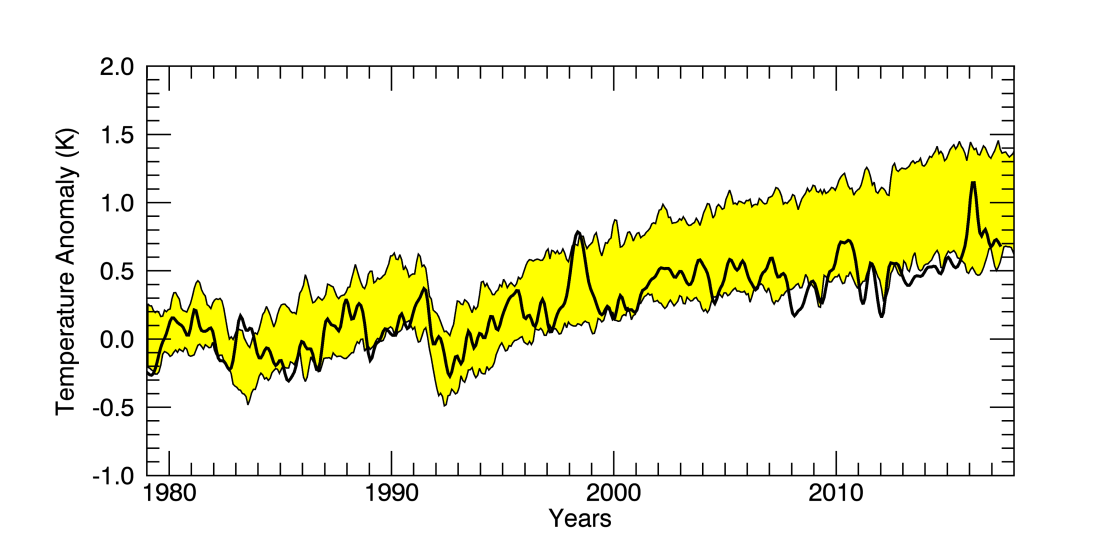
Fig. 1. Global (70S to 80N) Mean TLT Anomaly plotted as a function of time. The black line is the time series for the RSS V4.0 MSU/AMSU atmospheric temperature dataset. The yellow band is the 5% to 95% range of output from CMIP-5 climate simulations. The mean value of each time series average from 1979-1984 is set to zero so the changes over time can be more easily seen. Note that after 1998, the observations are likely to be in the lower part of the model distribution, indicating that there is a small discrepancy between the model predictions and the satellite observations.(All time series have been smoothed to remove variability on time scales shorter than 6 months.) Source : https://www.remss.com/research/climate/
You cannot predict the average weather, therefore you can’t predict the climate, which is just an average of weather. The hottest temperate every recorded was in Furnace Creek at a face-melting 57 degreee Celsius. The only inconvenient truth about that measurement, is that it was taken in 1913, not 2013. And most of the heat in the Earths’ climate is stored in water vapour, which comprises about 3-4 percent of the Earths’ atmosphere. “But we can’t control that” remarked an academic chemist I spoke to after the talk. Yes, we can’t, but then it’s out of our control and we shouldn’t craft policy as if it is. Climate Change policies are damaging for the economies of developing economies. Conflation with aspects of CFC Ozone hole scare. What about the global warming pause ? “It was shown not to have taken place”, I was told by the same man. Well, Fig 1. Tells a different story. “Disappeared” I suppose like the ‘censored data’ folder few heard about from the University of East Anglia Climate Research Unit regarding the medieval warming period ?
One of the commissioned pieces of this Distinguished Lecture was a booklet produced in cooperation with the Ipsos polling company, which found that about 40 % of the public in the U.S. figured there had more important things to worry about than global warming, whereas in the U.K. this number was about half. It should count for something that I’m not coming from a place of ignorance or inexperience, I’d like to think my degrees in applied maths and physics would put me in the category educated outsider with legitimate concerns about the veracity of the whole climate change narrative.
Yes, it’s about Math, yes, it’s about Physics, and on those bases, the climate change narrative doesn’t stack up. “Follow the science”, we’re told. Since the science is all-over-the-place in it’s messy measurements and predictions, this slogan usually ends up meaning “follow the politics”.
References
https://www.spectator.co.uk/article/john-kerrys-climate-blindspot/
https://www.remss.com/research/climate/

 Phyos
Phyos 